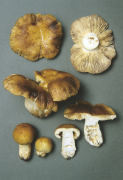
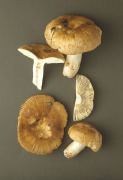
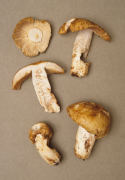
Russula foetens (Pers. ex Fr.) Fr. Stinktäubling, Russule fetide, Stinking Brittlegill. Cap 5–12cm across, globose at first, later convex, finally flattening, at times with a central depression, dull brownish ochre to honey-coloured, thick-fleshed, rigid, slimy or glutinous; margin furrowed and with small, low warts. Stem 50–120 x 15–40mm, whitish to buff, cylindrical or swollen in the middle, hard and rigid but easily breaking. Flesh white, irregular cavities forming in stem. Taste of gills very hot, of stem flesh almost mild, in addition bitter or oily, smell strongly oily or rancid. Gills adnexed, creamy, often brown spotted, thickish and well spaced. Spore print pale to medium cream (B–D). Spores somewhat globose with strong warts, up to 1.5µ high, isolated or an occasional fine line joining them, 8–10 x 7–9µ. Cap cystidia cylindrical, tapering or spindle-shaped, not reacting to SV. Habitat under broad-leaved trees or conifers. Season late summer to late autumn. Common. Not edible. Distribution, America and Europe. |